
Learn
CBD Dosage for Dogs: The Complete Weight-Based Guide
"How much do I give my dog?" is the first question almost every pet owner asks about CBD — and it's a fair one, because unlike a prescription medication, CBD dosing for pets isn't standardized across brands. Here's how dosing actually works, why the format of your CBD product matters as much as the dose itself, and how to apply it in practice.
CBD dosing is based on body weight, not age or breed
Most CBD dosing guidance for dogs is built around body weight because that's the strongest predictor of how a given amount of any compound will distribute through a dog's system. A 70-pound Labrador and a 8-pound Chihuahua process the same drop of oil very differently — the Labrador has far more body mass to dilute it across. That's why almost every reputable CBD product for pets — including this one — gives you a weight-based range rather than a single universal dose.
The general approach recommended by most holistic and integrative veterinarians is to start low and observe. Begin at the lower end of the recommended range for your dog's size, give it consistently for 5–7 days at the same time each day, and pay attention to how your dog responds — energy level, appetite, mobility, and general demeanor. If you don't see the response you're looking for after one to two weeks, many owners move toward the higher end of the range before assuming the product isn't a fit. There's no need to rush this — cannabinoids build up gradually with consistent use rather than working like an on/off switch.
Why isolate-based tinctures make dosing more predictable
Not all CBD dosing is equally precise. A full-spectrum or broad-spectrum tincture contains a mixture of dozens of plant compounds in ratios that can vary batch to batch, which makes it harder to know exactly how much active CBD is in any given drop. An isolate-based tincture — like Pet Omega Hemp's formula — starts from pure, lab-verified CBD and CBG molecules, so the potency per milliliter is a known, stable number rather than an estimate. That doesn't make every dose scientifically exact down to the milligram (dropper-based dosing is inherently an approximation), but it does mean the number on the label reflects what's actually in the bottle, batch after batch. If you want to understand the isolate-versus-full-spectrum tradeoff in more depth, see our guide to full-spectrum vs. isolate CBD.
How to use a dropper accurately
Squeeze slowly, count drops
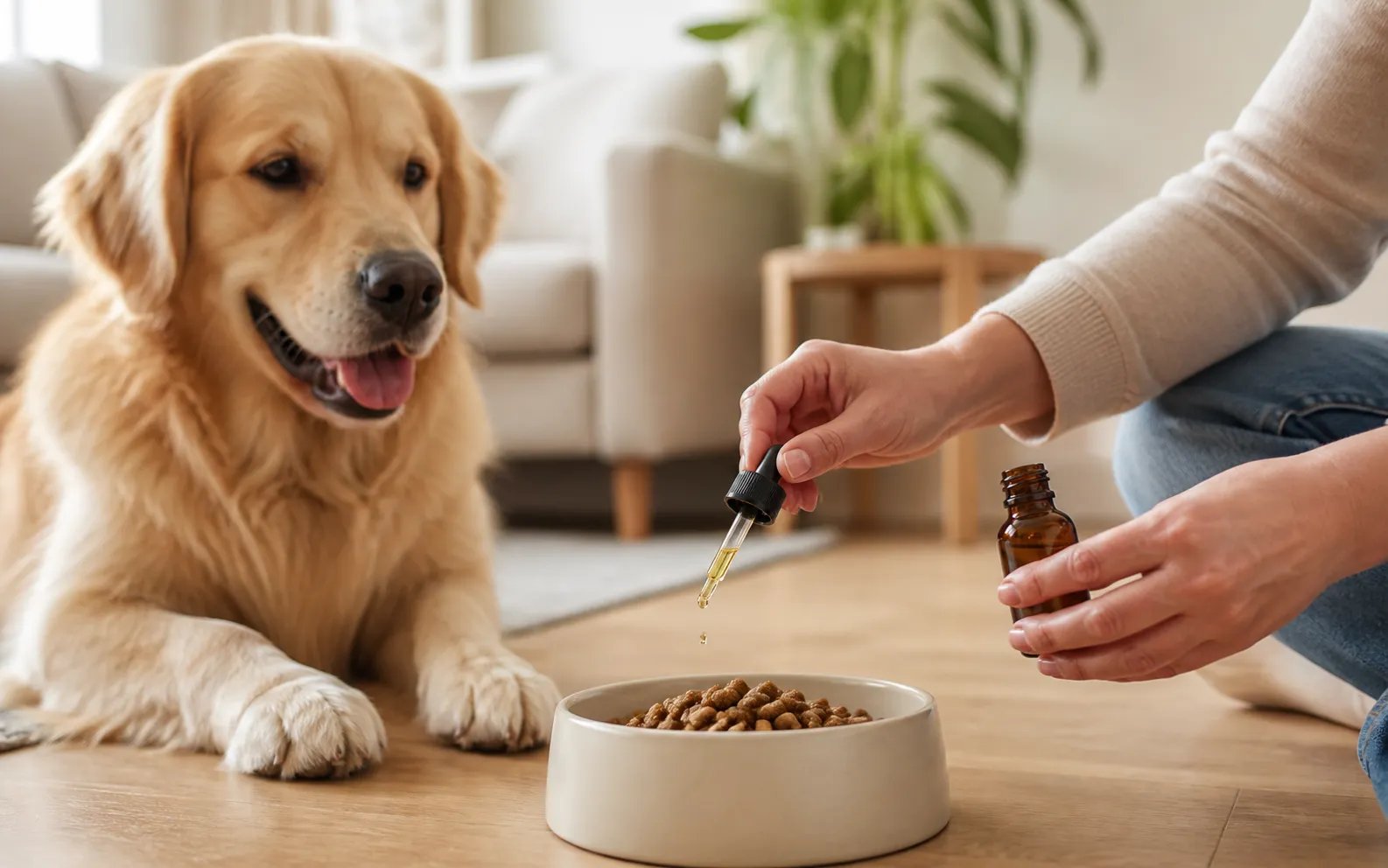
Hold the dropper vertically over your dog's food or a treat and squeeze gently, counting each individual drop as it falls. Squeezing too quickly can pull multiple drops into the bulb at once, making your count unreliable.
Apply to food, not directly in the mouth
Most dogs accept the oil more readily mixed into a small amount of food or dabbed onto a treat than dropped directly onto the tongue, which also reduces the chance of a struggling dog spilling the dose before it's fully delivered.
Keep timing consistent
Giving the AM and PM doses at roughly the same times each day helps maintain steadier levels in your dog's system than dosing at random intervals.
Store the dropper clean
Wipe the dropper tip before returning it to the bottle to avoid introducing food residue, and keep the bottle upright and tightly capped between uses.
Pet Omega Hemp's specific dosing guide
Apply directly to your pet's food or a treat, twice daily. This is a concentrated formula — a little goes a long way.
Wondering how a tincture like this stacks up against treats or capsules for dosing purposes? See CBD oil vs. treats vs. capsules.
Always consult your veterinarian first
Talk to your veterinarian before starting any new supplement — this is especially important for puppies, pregnant or nursing dogs, and any dog currently taking other medications, since your vet can review potential interactions specific to your dog's health history.
Your vet can also review the product's Certificate of Analysis alongside you if they have specific interaction concerns, since it lists exactly what's in the bottle. CBD is a supplement, not a treatment for any diagnosed medical condition, and nothing here should be taken as veterinary advice for your individual dog.